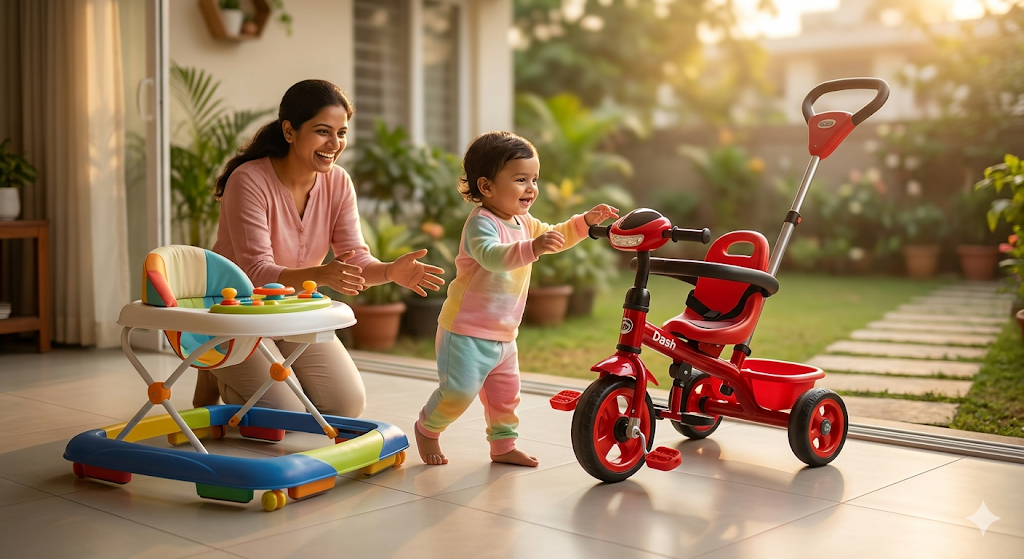
Baby Walkers and Dash Tricycles: Introducing Your Toddler to Mobility
Baby Walkers and Dash Tricycles: Introducing Your Toddler to Mobility
The moment your toddler takes their first steps is magical, but giving them the right tools for early mobility builds crucial motor skills and spatial awareness. Before you buy that first ride, discover why ergonomic designs in baby walkers and Dash tricycles are vital for your child’s physical development and safety.
Watching your little one transition from crawling to taking their first assisted steps is one of the most exciting milestones of parenthood. In the bustling households of Pimpri-Chinchwad (PCMC), from the high-rises of Wakad to the residential colonies of Thergaon, parents are constantly searching for the best ways to support their child’s early development. However, introducing mobility isn’t just about keeping a toddler entertained; it is a critical phase of physical and cognitive growth.
Choosing the right mobility aids—whether it is a carefully designed baby walker or a sturdy Dash tricycle—can significantly impact your child’s confidence, balance, and spatial awareness. At Bodke Cycles, we understand that your child’s first set of wheels is a major investment in their development. Let’s explore the science, safety, and joy behind selecting the perfect mobility tools for your toddler.
The Safety Consensus: What Every Parent Must Know About Baby Walkers
When discussing baby walkers, the absolute priority is safety. According to leading international child safety organizations, including detailed research and guidelines published by bodies like Kidsafe NSW, the use of traditional seated baby walkers requires strict parental awareness and environmental management.
Historically, older models of baby walkers posed risks because they allowed infants to move quickly across rooms, potentially reaching hazardous areas like stairs, hot ovens, or low tables with hot drinks. Furthermore, child development experts note that spending excessive hours in a seated walker can sometimes alter natural muscle development, as toddlers tend to push off with their toes rather than practicing the flat-footed stance required for independent walking.
To align with this global safety consensus, modern pediatric guidelines recommend the following when considering a baby walker:
- Strict Active Supervision: A baby walker is not a babysitter. Toddlers should only use walkers under the direct, watchful eye of an adult.
- Time Limits: Limit walker time to short bursts of 15 to 20 minutes a day. This ensures the child still gets plenty of “tummy time” and floor-based crawling, which are essential for core strength.
- Hazard-Free Zones: Before placing your child in a walker, the environment must be completely toddler-proofed. This means blocking all stairways with secure gates, removing rugs that could cause tripping, and ensuring all hot liquids and dangerous objects are pushed far out of reach on countertops.
- Push-Behind Alternatives: Many parents today are opting for “push-behind” walkers alongside traditional seated ones. These stable, wheeled toys require the child to pull themselves up to a standing position and push the toy forward, which heavily promotes flat-footed walking and core balance.
Features of a Modern, Safe Baby Walker
If you choose to use a seated baby walker for short periods of supervised play in your Pune apartment, selecting the right model is critical. At Bodke Cycles, we stock baby walkers that adhere to modern ergonomic and safety expectations.
When evaluating a walker, look for a base that is significantly wider than the top seat. This wide-stance geometry prevents the walker from easily tipping over if the child bumps into a wall or piece of furniture. Additionally, modern walkers often feature “friction pads” or “grip strips” on the base. If a wheel goes over a sudden drop—such as a small step down into a balcony—these pads instantly grip the floor to halt movement.
The seat should also be heavily padded and highly adjustable. As your child grows week by week, you must be able to adjust the height of the walker so that their feet are flat on the floor, preventing the “toe-walking” habit that experts warn against.
Enter the Dash Tricycle: The Next Step in Motor Skills
Once your toddler has mastered independent walking—usually between the ages of 1.5 to 3 years—their need for speed and exploration grows exponentially. This is the perfect time to introduce them to a tricycle. Among the most trusted names for this developmental stage is the Dash Tricycle.
A tricycle is much more than a toy; it is a complex developmental tool. Here is why transitioning your child to a Dash tricycle is a brilliant move for their physical and cognitive growth:
- Bilateral Coordination: Pedaling a tricycle requires a child to use both sides of their body simultaneously but in alternating movements. Pushing down with the left foot while lifting the right, all while using both hands to steer, builds incredible neurological pathways in the brain.
- Spatial Awareness and Steering: Unlike a walker, a tricycle gives a child the freedom to navigate their environment deliberately. They learn cause and effect: “If I turn the handlebars left, I go left.” They learn how to judge distances to avoid hitting the living room sofa or the park bench.
- Leg Strength and Cardiovascular Health: Pushing pedals against the resistance of the floor or pavement is an excellent form of early strength training. It builds the quadriceps, hamstrings, and calf muscles, laying the foundation for transitioning to a larger bicycle later on.
Dash tricycles are particularly favored because they often feature parent-control handles. This allows you to guide your child safely through the busy parks of PCMC or along Kalewadi Main Road while they get the hang of pedaling. As they grow confident, the handle can be removed, granting them full independence.
The Local Context: Where to Ride Safely in PCMC
Pune’s urban layout offers great spaces for toddlers to safely practice their new mobility skills. While indoor apartment spaces are great for initial baby walker use, tricycles demand a bit more open space.
We highly recommend taking your newly equipped toddler to the traffic-free zones in your local housing society, or to the dedicated play areas in public parks around Thergaon and Wakad. Early morning rides (between 7:00 AM and 9:00 AM) are ideal, as the Pune sun is gentle and the pathways are relatively empty, giving your child the safe runway they need to build their confidence.
The Bodke Cycles Advantage: Why Buy Locally?
When buying a baby walker or a toddler’s first tricycle, the “Do-It-Yourself” online assembly route is often a recipe for frustration and safety hazards. A misaligned wheel or a loose steering column on a tricycle can lead to immediate falls.
By visiting Bodke Cycles, you bypass the guesswork. Our 53 years of heritage in the bicycle industry means we understand exactly what young families need.
- Tactile Sizing: You can place your child in the walker or on the Dash tricycle right in our 7000 sq. ft. showroom to ensure their feet comfortably reach the floor or the pedals.
- Professional Assembly: Our expert mechanics fully assemble and safety-check every tricycle and walker before it leaves the store, ensuring all nuts, bolts, and safety friction pads are perfectly secured.
- Local Trust: With over 8,500 excellent reviews from the PCMC community, you are buying from a legacy institution that prioritizes your child’s safety above all else.
Introducing your child to the joy of movement is a monumental step. Make sure you support their journey with the safest, most ergonomically sound products on the market.
Find the Perfect Ride for Your Little One Today:
Bodke Cycles
Address: JQ4H+V88, Cycle Mahal, Rahatni phata, No. 2, Kalewadi Main Rd, Jai Malhar Nagar, Samarth Colony, Thergaon, Pimpri-Chinchwad, Maharashtra 411033
Phone: 07620150160
Explore our Kids Collection: https://www.bodkecycles.co.in/